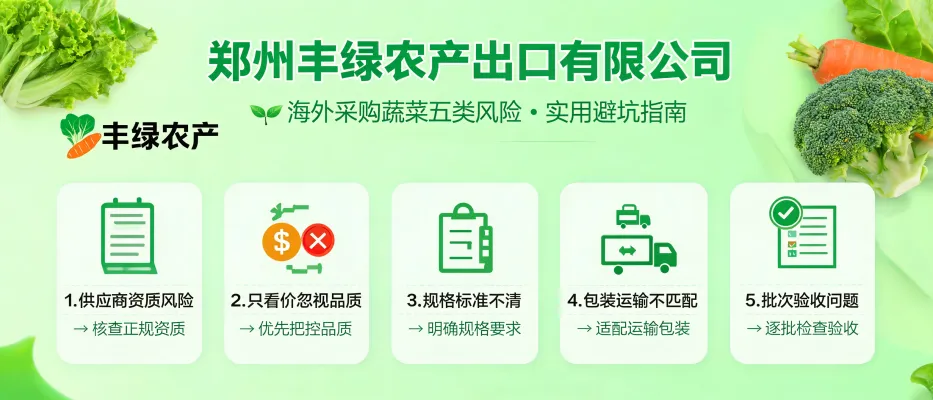
Procuring fresh vegetables across borders carries operational, quality and contractual risks. This page summarizes five common procurement risks relevant to tomatoes, cucumbers, eggplants, peppers, garlic, carrots, ginger and potatoes — and provides practical mitigation actions buyers can apply when evaluating suppliers and designing long-term supply relationships.
Buyers may accept suppliers without verifying production capacity, export experience, certifications or hidden cost elements (e.g., phytosanitary fees, packaging surcharges, seasonal price premiums). Ambiguous price terms and delivery responsibilities lead to disputes.
Fresh produce quality can vary by season, field, or packaging line. Lack of standard sampling and acceptance criteria causes mismatch with buyer specifications (size, Brix, defects, shelf life).
Ambiguity about product grade, variety name, net weight, carton markings or regulatory labelling leads to clearance delays and market refusals.
Incorrect packaging materials, insufficient ventilation, or failures in temperature control during transit can reduce shelf life or increase waste on arrival.
Without clear batch numbering and traceability, a problem in one shipment can jeopardize the whole program and complicate recalls or quality investigations.
| Risk | Immediate action |
|---|---|
| Supplier qualification & commercial terms | Request documentation pack + itemized commercial offer |
| Quality consistency | Agree acceptance criteria and sampling plan |
| Specification & labelling | Finalize spec sheet + labelling templates |
| Packaging & cold chain | Define packing materials and T°C monitoring |
| Batch delivery & traceability | Require batch IDs and delivery notification protocol |
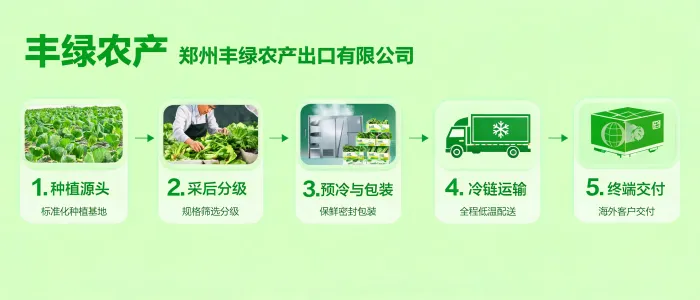
Zhengzhou Fenglu Agricultural Export Co., Ltd. works with growers and packers to document supply capabilities and quality controls for exported vegetables. For buyers seeking reliable B2B partnerships, we provide supplier documentation, sample shipments, and coordinated pre-shipment inspections to reduce the procurement risks described above.
If you are evaluating long-term suppliers or planning pilot imports, start with a clear specification and a staged trial to validate quality, packaging and delivery workflows before scaling volume.
 294
|
294
|
 Zhengzhou Fenglu Agricultural Export Co., Ltd.
standardized supply chain
fresh vegetable export
cold chain logistics
Zhengzhou Fenglu Agricultural Export Co., Ltd.
standardized supply chain
fresh vegetable export
cold chain logistics
 313
|
Zhengzhou Fenglu Agricultural Export Co., Ltd.
fresh vegetable export order
quality inspection
full-process delivery
agricultural product quality assurance
313
|
Zhengzhou Fenglu Agricultural Export Co., Ltd.
fresh vegetable export order
quality inspection
full-process delivery
agricultural product quality assurance
 257
|
新鲜蔬菜出口
标准化供应链
郑州丰绿农产出口有限公司
新鲜胡萝卜出口
257
|
新鲜蔬菜出口
标准化供应链
郑州丰绿农产出口有限公司
新鲜胡萝卜出口
 186
|
Zhengzhou Fenglu Agricultural Export Co., Ltd.
vegetable export experience
batch management
freshness control
multi-market supply
186
|
Zhengzhou Fenglu Agricultural Export Co., Ltd.
vegetable export experience
batch management
freshness control
multi-market supply
 320
|
fresh vegetables export
freshness retention
supply chain standardization
Zhengzhou Fenglu Agricultural Export Co., Ltd.
320
|
fresh vegetables export
freshness retention
supply chain standardization
Zhengzhou Fenglu Agricultural Export Co., Ltd.