B2B Guide: Evaluating Fresh Vegetable Suppliers and Product Quality
2026-08-18
Zhengzhou Fenglu Agricultural Export Co., Ltd.
Industry Guide
Zhengzhou Fenglu Agricultural Export Co., Ltd. presents a practical B2B procurement guide for overseas wholesalers, importers, retailers and foodservice buyers. Learn how to assess fresh vegetable suppliers and product quality across product specifications, appearance and maturity, batch stability, export packaging and cold-chain, delivery lead times, required quality documentation, and supplier communication.

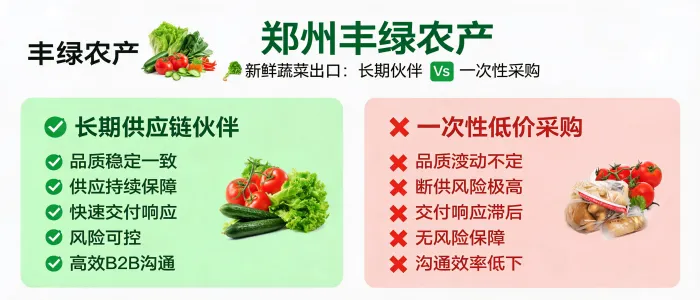
Selecting a fresh vegetable supplier for international trade requires more than comparing prices. Overseas wholesalers, importers, retailers and foodservice buyers need to evaluate product specifications, appearance, batch consistency, export handling, delivery planning and supplier communication as one connected procurement process.
This practical guide from Zhengzhou Fenglu Agricultural Export Co., Ltd. provides a structured way to assess fresh vegetable suppliers for products such as tomatoes, cucumbers, eggplants, peppers, garlic, carrots, ginger and potatoes.
What should B2B buyers evaluate first?
A reliable procurement assessment should connect the buyer’s sales channel and destination-market requirements with the supplier’s ability to provide consistent products and organized export support. The key questions are:
- Are the product specifications clearly defined before ordering?
- Do appearance and maturity match the intended market and use?
- Can the supplier maintain reasonable consistency from batch to batch?
- Are packaging, temperature control and shipment planning suitable for international delivery?
- Can the supplier communicate clearly and provide the quality documents required for the transaction?
B2B fresh vegetable supplier evaluation checklist
| Evaluation area |
What buyers should clarify |
Why it matters |
| Product specifications |
Product type, size or grade, order quantity, packing format and destination requirements. |
Clear specifications reduce misunderstandings during quotation, sampling and shipment. |
| Appearance and maturity |
Color, firmness, visible condition, maturity level and suitability for the buyer’s distribution or foodservice needs. |
Freshness and maturity influence handling, presentation and intended use. |
| Batch consistency |
Whether agreed specifications can be applied consistently across different batches and shipment periods. |
Consistent supply supports more predictable purchasing and downstream operations. |
| Packaging and cold-chain suitability |
Outer packaging, protection during handling, labeling needs and temperature-control arrangements appropriate to the product and route. |
Packaging and temperature management help protect product condition during export logistics. |
| Delivery lead time |
Preparation schedule, shipping plan, destination port or delivery point, and communication of possible changes. |
Lead-time clarity helps buyers coordinate inventory, sales and receiving arrangements. |
| Quality documentation |
Which documents, inspection records or destination-market materials are required for the order. |
Document alignment supports smoother import review and transaction management. |
| Supplier responsiveness |
Response speed, accuracy of answers, handling of specifications and ability to communicate order updates. |
Clear communication is essential when fresh products, schedules and destination requirements are involved. |
Key considerations by procurement stage
01 · Before quotation
Define the order clearly
Share the target product, specifications, estimated quantity, packaging preference, destination and expected timing. For mixed-product purchasing, identify the requirements for each vegetable rather than using one general quality description.
02 · Before confirmation
Confirm quality expectations
Discuss appearance, maturity, firmness, acceptable condition, pack size and labeling. Buyers should also confirm how the agreed requirements will be checked before shipment and reflected in order communication.
03 · Before shipment
Review handling and documents
Verify the planned packing method, shipping schedule, temperature-control requirements and documents needed for the destination market. This step connects product quality with practical export execution.
04 · During cooperation
Track communication and consistency
Keep product specifications, shipment details and quality feedback organized. A supplier’s ability to respond accurately and address changes is an important part of long-term B2B cooperation.
Product-specific questions for fresh vegetable buyers
Different vegetables may require different discussions about condition, maturity, packing and handling. Buyers can use the following questions when preparing an inquiry:
- Tomatoes, cucumbers, eggplants and peppers: confirm size, color or maturity expectations, firmness and protection against handling damage.
- Garlic, carrots, ginger and potatoes: confirm product condition, grading or size requirements, surface appearance, packing format and storage or transport considerations.
- All products: align the order specification with the destination market, intended sales channel and required export documentation.
Why supplier communication matters in international procurement
Fresh vegetable export orders involve multiple details that must remain consistent: product selection, quality expectations, packaging, shipment timing and destination requirements. A supplier that communicates these details clearly gives buyers a stronger basis for planning and review.
For B2B buyers, communication should be specific rather than limited to general statements about quality. Useful supplier responses should address the actual product, order requirements, export arrangement and documentation needed for the transaction.
A practical inquiry framework for buyers
-
1
Describe your purchasing plan: product list, estimated quantity, destination and expected shipment timing.
-
2
Set measurable expectations: specifications, appearance, maturity, packing and labeling requirements.
-
3
Review export readiness: packaging, cold-chain suitability, lead time and destination-market documentation.
-
4
Confirm the communication process: agree how order updates, quality feedback and any changes will be handled.
Working with Zhengzhou Fenglu Agricultural Export Co., Ltd.
Zhengzhou Fenglu Agricultural Export Co., Ltd. focuses on the international export of fresh vegetables, including tomatoes, cucumbers, eggplants, peppers, garlic, carrots, ginger and potatoes. The company serves B2B customers across Asia, Europe and the Americas, the Middle East and Africa.
With a commitment to controlling the quality of each export batch, Fenglu approaches procurement through product clarity, supply-chain coordination and honest communication. Buyers can use this checklist to prepare a more precise inquiry and evaluate whether a fresh vegetable supplier is suitable for their market, product mix and export requirements.