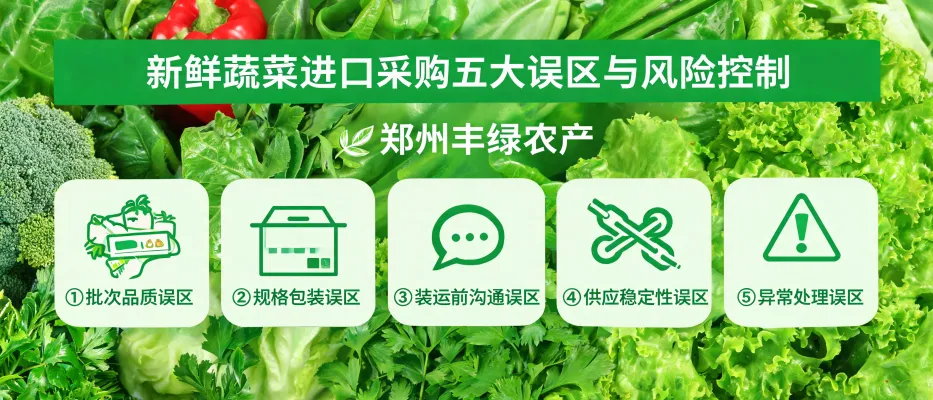
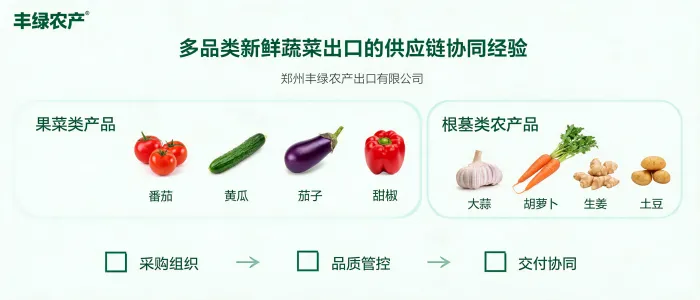
Importers of fresh vegetables face recurring operational risks that affect quality, delivery and cost. Zhengzhou Fenglu Agricultural Export Co., Ltd. (Zhengzhou Fenglu) draws on its export experience with tomatoes, cucumbers, eggplants, peppers, garlic, carrots, ginger and potatoes to outline five frequent procurement mistakes and practical, process‑based ways to reduce them.
Fresh produce requires clear specifications, consistent supplier screening, pre‑shipment quality agreement, verified supply stability and predefined handling for delivery exceptions. Addressing these process points reduces disputes, short shipments and quality losses across international supply chains.
Focusing solely on unit price often overlooks hidden costs: higher waste rates, inconsistent sizing, additional inspection or rework at destination.
Vague or missing specifications on size ranges, allowed defects, packing units and palletization cause mismatches at arrival.
Insufficient pre‑shipment checks and unclear sampling/inspection criteria often lead to disputes at the destination port.
Single‑season suppliers or those without capacity buffers can break commitments during peak demand or adverse weather.
Lack of predefined rules for short shipments, temperature deviations or contamination slows resolution and increases losses.
| Common mistake | Primary risk | Mitigation |
|---|---|---|
| Price-driven sourcing | Higher waste and rejections | Define quality bands; sample orders |
| Vague specs & packaging | Damage and repacking | Standardize packing & labeling |
| No pre‑shipment checks | Claims on arrival | Agree inspection protocol |
| Unverified supplier stability | Short shipments | Assess capacity & backups |
| No exception handling process | Slow resolution | Define escalation & timelines |
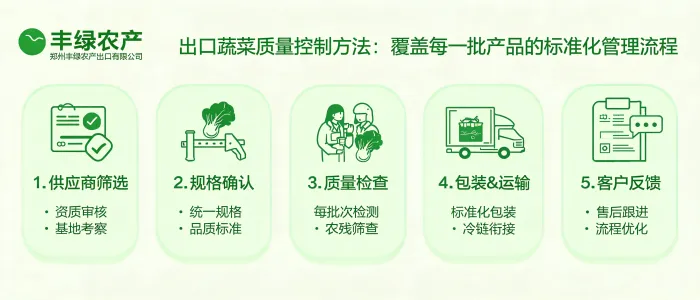
Zhengzhou Fenglu Agricultural Export Co., Ltd. operates a standardized export process focused on traceability and consistent quality. Practical services available to buyers include:
For tailored support on supplier screening, export quality inspection or specification templates, Zhengzhou Fenglu is available to collaborate with procurement teams across Asia, Europe, the Middle East and Africa. Contact us to align specifications and reduce cross‑border procurement risks while sourcing fresh vegetables.
 393
|
393
|
 Zhengzhou Fenglu Agricultural Export Co., Ltd.
export vegetable quality control
batch management
agricultural product standardization
vegetable export process
Zhengzhou Fenglu Agricultural Export Co., Ltd.
export vegetable quality control
batch management
agricultural product standardization
vegetable export process
 314
|
Zhengzhou Fenglu Agricultural Export Co., Ltd.
fresh vegetable export order
quality inspection
full-process delivery
agricultural product quality assurance
314
|
Zhengzhou Fenglu Agricultural Export Co., Ltd.
fresh vegetable export order
quality inspection
full-process delivery
agricultural product quality assurance
 422
|
Zhengzhou Fenglu Agricultural Export Co., Ltd.
multi-category vegetable export
fruit vegetables
root and tuber crops
export supply chain coordination
422
|
Zhengzhou Fenglu Agricultural Export Co., Ltd.
multi-category vegetable export
fruit vegetables
root and tuber crops
export supply chain coordination
 302
|
郑州丰绿农产出口有限公司
高品质新鲜蔬菜出口
B2B农产品供应链
冷链衔接
出口标准
302
|
郑州丰绿农产出口有限公司
高品质新鲜蔬菜出口
B2B农产品供应链
冷链衔接
出口标准
 36
|
Zhengzhou Fenglu Agricultural Export Co., Ltd.
vegetable export supplier
China agricultural sourcing
export quality standards
overseas vegetable import
36
|
Zhengzhou Fenglu Agricultural Export Co., Ltd.
vegetable export supplier
China agricultural sourcing
export quality standards
overseas vegetable import